
From growing vines to making wine….Dad’s “Retirement Project”
It all started, as many slightly chaotic but strangely compelling things do, with one of Dad’s “wacky ideas”, the kind he delivers with such genuine, endearing excitement that you momentarily forget you already have far too much going on, and instead think, well yes, obviously, this is the best idea you’ve ever had, why wouldn’t we do that?
“A fun retirement project whilst I hand over the farming reins” he said.
Fifteen acres of it, as it turns out, which is an important detail to casually glaze over, but by that point we were already emotionally committed, if not entirely logically on board.
I wouldn’t say we all agreed… but no one said no, and somehow that was enough. A year later the field had been cultivated, the vines had been ordered from Germany, and we were working with our consultant Duncan to choose varieties that would suit our soil, not just because we’re organic, but because, naturally, Dad had decided that wasn’t quite ambitious enough and that we should take the next step into biodynamics. And just like that, we were planting a 15-acre vineyard.
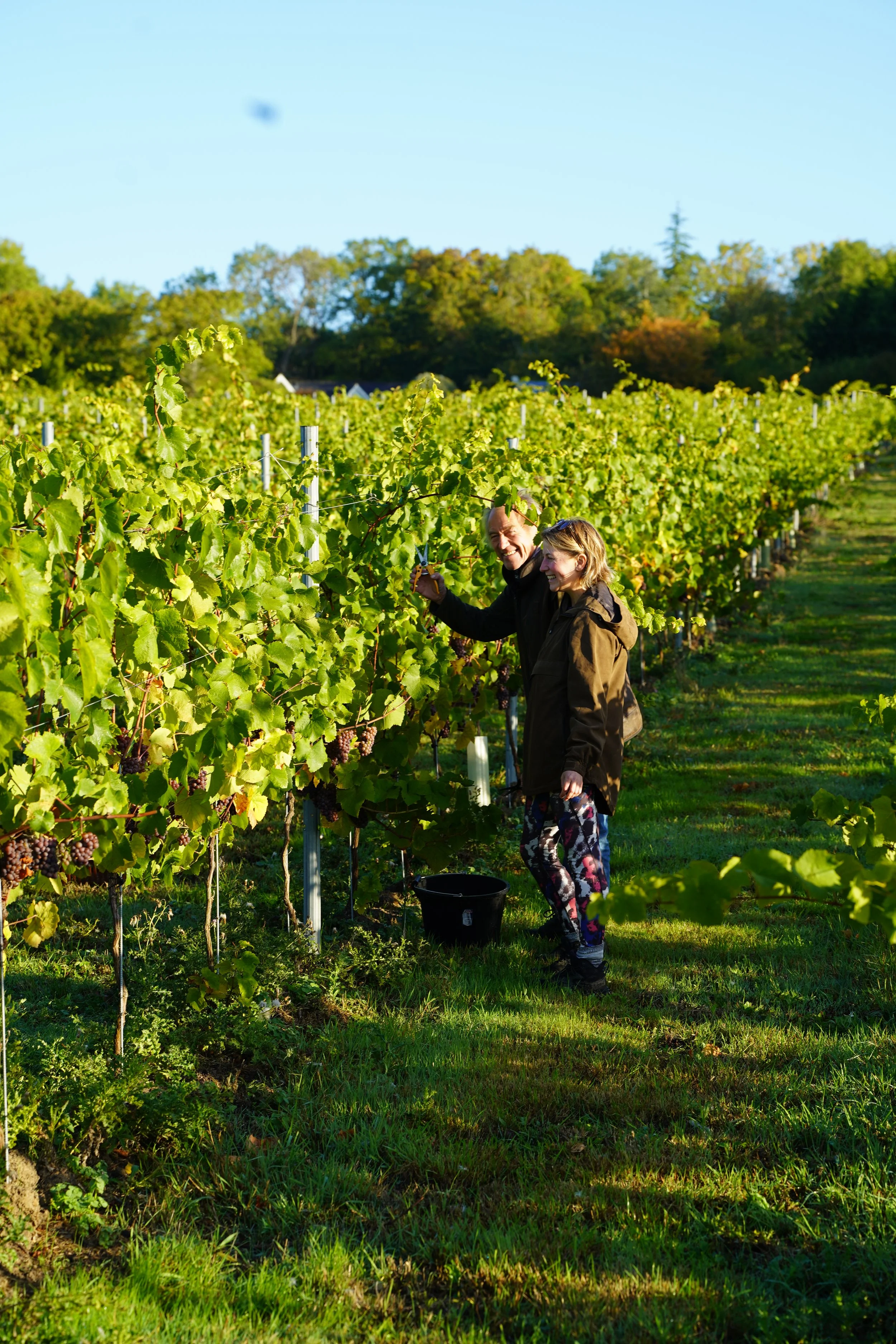
The False Sense of Security
The first couple of years lull you into a false sense of security. The vines are small, everything feels quite manageable, and you think, this is quite straightforward, what was everyone worried about? Then the terminology begins.
Pruning, training, bud rubbing, leaf stripping, tucking in, wire fixing, undervine cultivation, biodynamic teas and sprays… and I’m standing there nodding along as if I have even the faintest idea what any of it means. Even as a farmer’s daughter, I had no clue what “cultivation” involved, let alone something like “roller hacking” which Dad would casually mention as if it were common knowledge.
Every few weeks there’d be a new “job” announced, and I’d look blankly at him, while the agronomist added in a few organically certified sprays for good measure and talk of sheep for ‘mowing’ the grass entered the conversation, at which point my brain would switch off altogether. All the while, I was supposed to be training as a craniosacral therapist, which couldn’t have felt further removed from what I was actually doing day-to-day.
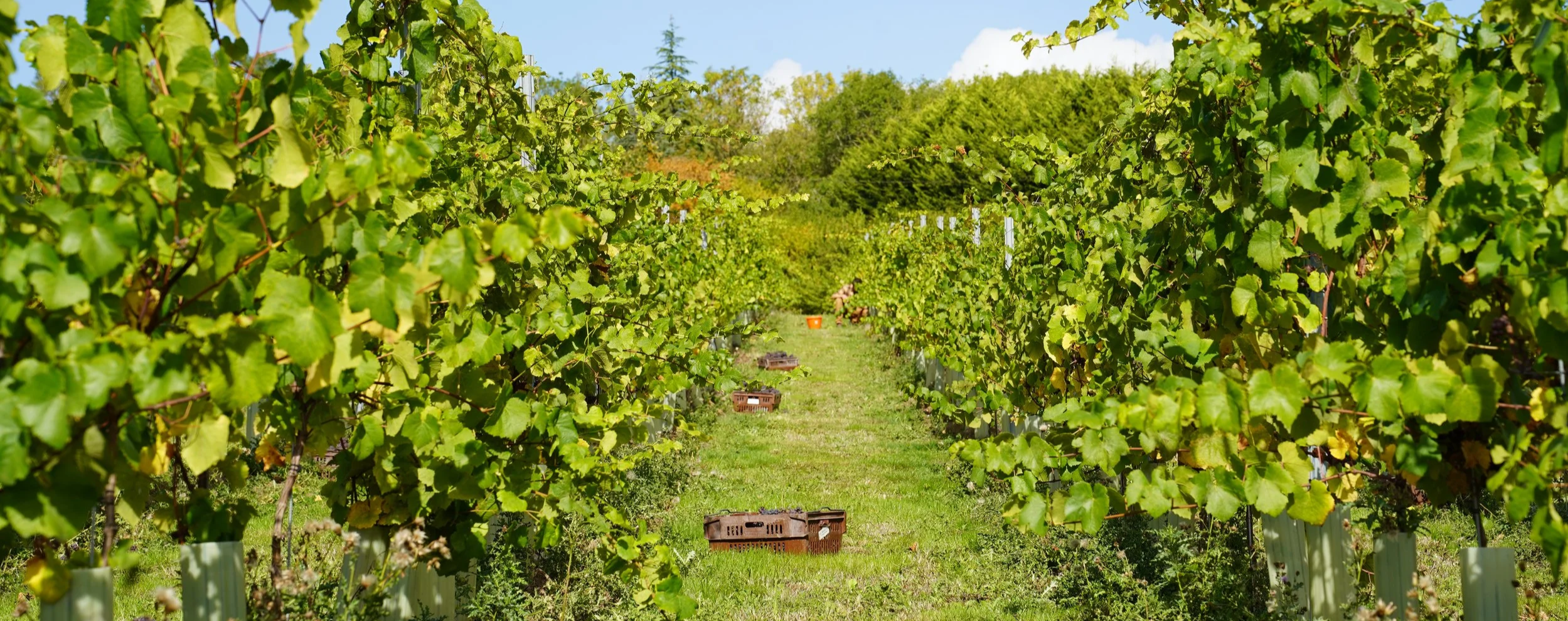
2024: Our First Harvest
It soon became apparent that a 15-acre vineyard isn't something you casually manage on the side. Jobs don't wait. Before you've finished one, three more have appeared, and all of them are urgent. We needed freelancers, volunteers, and anyone willing to help us tackle the list of things that needed doing now, or ideally, yesterday.
Meanwhile, the bank balance was doing one very consistent thing: going down. No grapes, no wine, just a steady stream of outgoings. It was a very convincing business model so far. That said, we started visiting other wineries and meeting lovely winemakers who were knowledgeable and refreshingly grounded. For the first time, it felt like this might be worth it, if only to be part of that world.
Then came our first harvest in 2024. It felt less like a milestone and more like stepping into the complete unknown. We had no idea what we'd get. Somewhere between 500kg and 5,000kg felt like a reasonable guess, which tells you everything you need to know.
There was also the issue of whether anyone would even want such a tiny quantity. We agreed that if all else failed, we'd just turn the grapes into compost tea. In hindsight, that feels like a very calm response to what could've been a minor disaster.
Anyway, we gathered a brilliant group of volunteers and got on with it. Ten hours later, we'd handpicked 3,500kg across 18,000 vines and five varieties. It felt nothing short of miraculous. Somehow, it was enough for a winery to take them. Dad delivered them that night, and just like that, we'd completed our first harvest. Still no money, of course, but there was a definite sense that we hadn't completely lost the plot.
Scaling Up the Chaos
By the second year, we thought we had more of a handle on things, which was optimistic. We were told to estimate yields by counting bunches and doing some calculations, and what we thought might be two or three times the previous year, suddenly came out at over 30 tonnes, which caused an internal panic about who was going to buy that many grapes. We spoke to more winemakers, who very calmly told us not to panic because yields rarely match estimates, so we dialled it back, stood a few buyers down (slightly awkward), and convinced ourselves it would all be fine.
Meanwhile, we started hearing on the grapevine (literally) that it was shaping up to be the best year England had ever seen for grapes, with a huge excess expected across the board. Of course, all of this is happening alongside the underlying fear that we might not make it to harvest at all. In early spring, it’s frost - you find yourself checking temperatures obsessively, knowing that one cold night at the wrong moment can wipe out entire shoots before the season has even begun, and there is very little you can do about it except hope you’re not the unlucky one that year. Then, just as you get closer to harvest and start to feel cautiously optimistic, along come the diseases.
Downy mildew, fruit fly, more things I had never given a second thought to before now suddenly feel like very real threats capable of undoing months of work in a matter of days. And again, you can only manage what you can and hope you’re not the chosen vineyard that gets hit. So by the time harvest actually arrives, it’s not just about picking grapes - it’s relief. Slight disbelief. And the feeling that you’ve got away with something.
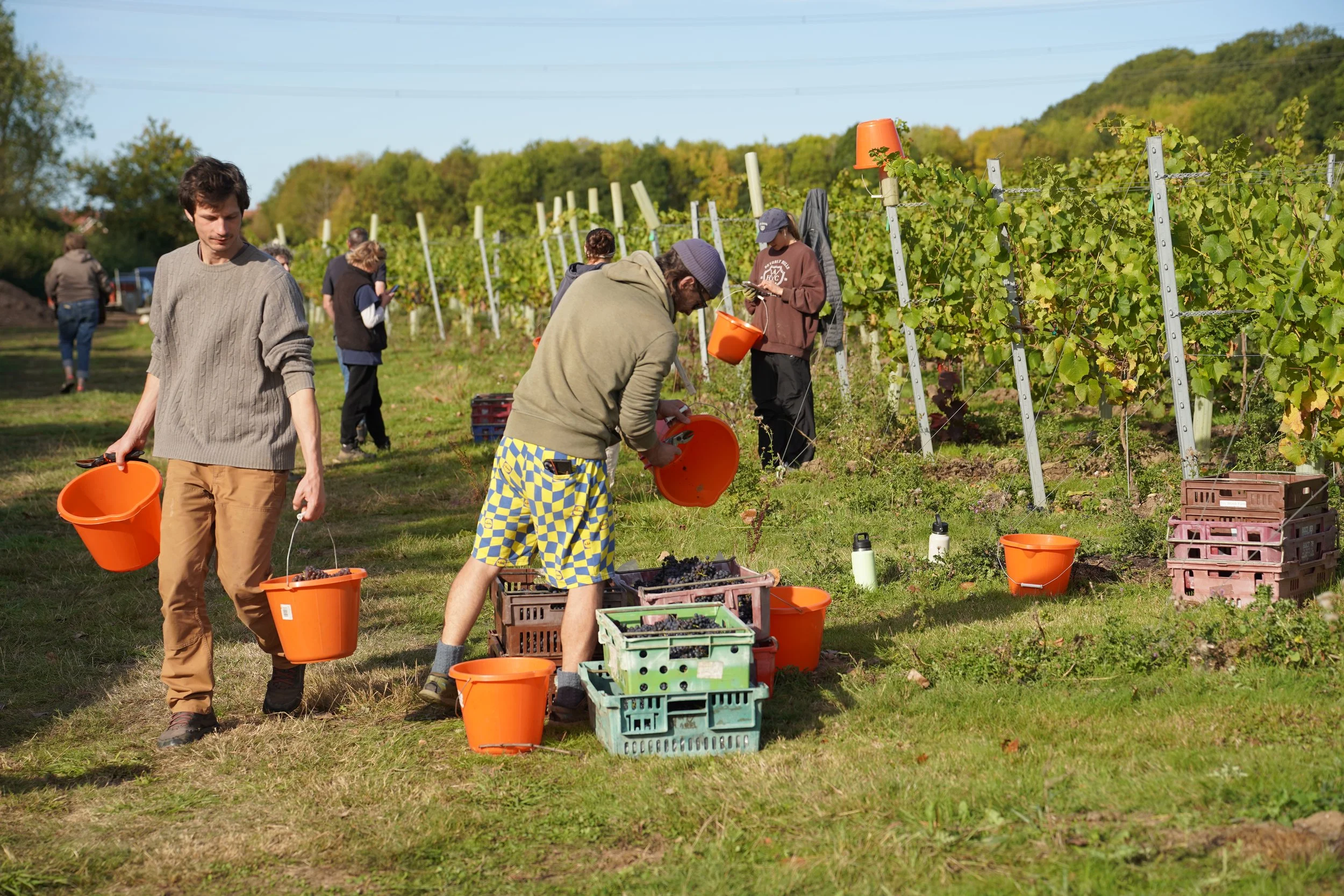
The Midnight Run to Kent
Harvest is a mix of adrenaline, chaos, and just about holding it together. You’re running on momentum and making decisions on the fly as you coordinate pickers, transport, and timings. Somehow it all feels possible in the moment because it has to be.
On day one, we start picking Pinot Noir and Pinot Gris. It’s immediately clear this isn't last year. There are far more grapes, everything is taking longer, and we’re frantically tallying dolavs and estimating weights. It is all against the clock because the haulier is already en route to Off Beat Wine in Salisbury.
We get it done in time, or at least, almost. Pickers are still going as the haulier prepares to leave, and the truth hits: we have far more than our “revised” estimations suggested. Worse, most of it is already off the vine. It leads to a brief, intense moment of: Oh god, what do we do now?
It’s 3pm. The haulier leaves with what he can fit, leaving the rest in baskets. I halt the picking and start frantically ringing every contact I’ve made. Unsurprisingly, no one has capacity. I cannot bear the thought of wasting a single grape, so naturally, I decide: Fine, we’ll just make our own wine. This was followed immediately by the more practical questions of how, where, and with whom.
By 7pm, a lifeline arrived: a winemaker in Kent knew someone who could take them. Archie and I loaded the van and set off. We made it seven miles before realising we were dangerously close to falling asleep, so we stopped for food, swapped drivers, and pushed on. We were equal parts exhausted and delirious until we delivered the grapes and finally made it home at midnight.
In the moment, the adrenaline makes you feel oddly capable. But the crash comes every single time. It is the kind where your body suddenly realises what you’ve put it through, leaving you wiped and wondering how you’re supposed to do it all again tomorrow.
It was also becoming clear that if this was just the first section, the rest of the vineyard was going to dwarf our estimates. Thankfully, the industry is more supportive than we deserve. A vineyard in Norfolk completely saved us; a conversation about 8 tonnes somehow turned into them taking 17. A total hero.
Between last-minute buyers, kind winemakers, and the decision to make a small amount of our own wine, every grape was pressed. That second harvest hit 24 tonnes. For the first time, money actually came in: a huge milestone after years of outgoings. A success, undeniably, but not without cost to our nervous systems at Tey Brook Farm. We all began to think Dad might, in fact, be a genius.
The Never-Ending Paperwork
Just when you think you’re nearing the finish line, someone casually asks if you’ve applied for your APPA licence yet, and you realise you are, in fact, nowhere near done.
What followed was six months of forms, HMRC visits, research, spreadsheets, and a level of admin I hadn’t mentally prepared for, all just to be able to get our wine back and sell it. Then of course there are labels, bottle shapes, corks versus caps, branding… and you realise you’ve somehow gone from being a grape grower, to a slightly wired grape exchange trader, to what feels like a full-time career in marketing.
Looking Back from 2026
So here we are in 2026, four years in, with our first wines about to be bottled, labels going through what feels like their hundredth revision, licences nearly approved, and the very surreal reality that we’re about to taste something that started as one of Dad’s “cool” ideas.
Curiously, as I write this, I have just noted that dad doesn't seem to be around so much now except at the tastings. And despite everything - the chaos, the uncertainty, the exhaustion, the adrenaline highs and inevitable crashes, and the mild identity crisis between vineyard work and craniosacral therapy training, I still find myself thinking he might have been right.
Although I also now completely understand why he meditates twice a day, every day, without fail. And I’m not far off joining him.